
How to Buy GRAM on Bybit: GRAM/USDT Spot Guide (ex-TON)
To buy GRAM on Bybit, deposit USDT, open the GRAM/USDT spot pair (renamed from TON/USDT on June 22, 2026), choose a market order for speed or a limit order for price control, and confirm the trade. GRAM is the same coin as Toncoin after its 1:1 rebrand — after buying, keep it on Bybit or withdraw to Tonkeeper for Fragment and Telegram Stars use.
How much GRAM for your USDT?
Live price, Bybit spot fee (0.1%) included.
One Coin, Two Tickers: Where GRAM Trades Under Which Name
| Venue | Ticker | Status |
|---|---|---|
| Bybit | GRAM/USDT | New ticker live since June 22, 2026 — order book and history carried over |
| Kraken | TON/USD, TON/USDT | Still the old ticker as of July 2026 — same coin |
| TON DEXs (STON.fi, DeDust) | TON | On-chain name unchanged; the network is still The Open Network |
| CoinGecko / CoinMarketCap | GRAM | Price pages renamed, historical charts preserved |
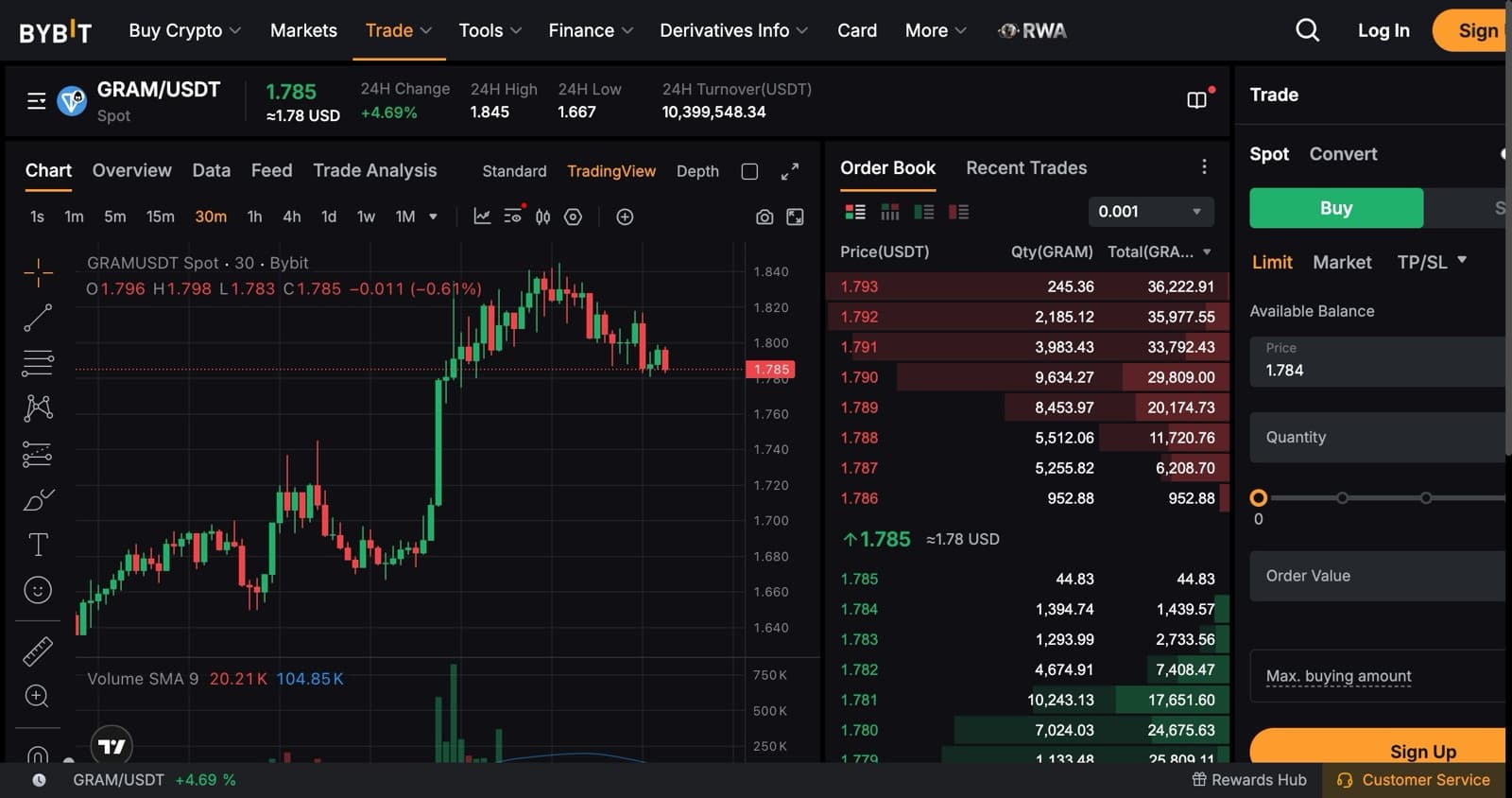
Buying GRAM on Bybit, Step by Step
- 1
Log in to Bybit and click 'Trade' in the top navigation, then select 'Spot'.
- 2
In the search box (top right), type 'GRAM' and select the GRAMUSDT trading pair (before June 22, 2026 it was listed as TONUSDT).
- 3
On the left side, choose your order type: 'Limit' (set your own price) or 'Market' (buy instantly at current price).
- 4
For a Market order: enter the USDT amount you want to spend → click 'Buy GRAM'.
- 5
For a Limit order: set your target price per GRAM → enter amount or total USDT → click 'Buy GRAM'.
- 6
Confirm the order details in the popup and click 'Confirm Buy'.
- 7
Your GRAM appears in your Unified Trading Account (Spot) within seconds.
- 8
To move GRAM to your wallet: go to Assets → Withdraw → select GRAM (TON network) → enter your Tonkeeper address → confirm.
In the US? Kraken lists it as TON
Bybit doesn't serve US customers. Kraken — licensed since 2011 — trades the same coin under its old TON ticker.
Trade TON (GRAM) on KrakenTON Is Now GRAM on Bybit — Don't Let the Ticker Confuse You
On June 15, 2026 Toncoin was officially renamed Gram after a community vote (81% in favor), and Bybit switched its spot pair from TONUSDT to GRAMUSDT on June 22, 2026. Nothing else changed: it's the same coin, on the same blockchain (still called The Open Network), converted 1:1 with no token swap and no action required from holders. If you held TON on Bybit before the change, your balance simply shows as GRAM now.
Practical implications when buying: search 'GRAM' in the spot search box (searching 'TON' may still redirect, but the pair is labeled GRAMUSDT); price history and charts carry over from the TONUSDT pair; and withdrawals still run on the TON network — so your Tonkeeper address works exactly as before. Other exchanges are migrating at their own pace: Kraken, for example, still lists the coin under the TON ticker as of July 2026.
Why Buy GRAM on Bybit's Spot Market
Bybit is one of the top three global crypto exchanges by volume, and its GRAMUSDT spot market is the most liquid venue to buy Gram (ex-Toncoin) outside of decentralized exchanges. Bybit's standard spot trading fee is 0.1% per trade — meaning buying $100 worth of GRAM costs $0.10 in fees. With the BGB (Bybit Token) fee discount enabled, this drops to 0.06%. Compare this to buying through a card provider on Bybit's 'Buy Crypto' section, which typically costs 2–4.5% — spot trading is 20–45x cheaper for anyone who already has USDT or fiat in their account.
The GRAMUSDT pair has consistent depth across the order book, meaning large orders (thousands of dollars worth) execute near the mid-market price without significant slippage. This is important if you're accumulating GRAM regularly — slippage on illiquid pairs can erode returns faster than trading fees. Bybit's spot market also has 24/7 access with no circuit breakers or trading halts, meaning you can execute during any market condition.
Buying GRAM via spot and then withdrawing to Tonkeeper is the most cost-effective path to self-custody. GRAM withdrawals on Bybit cost approximately 0.02 GRAM (a few cents) and arrive in Tonkeeper within 1–3 minutes. The complete path — deposit USDT → buy GRAMUSDT spot → withdraw GRAM to Tonkeeper — takes under 10 minutes and costs under 0.2% total.
Market Orders vs Limit Orders: Which to Use
A Market order buys GRAM immediately at the best available price. You specify how much USDT to spend (or how many GRAM to receive), click Buy, and the order fills instantly. Market orders are ideal when you want to buy immediately without waiting — for example, when GRAM is dipping and you want to buy before it recovers. The downside: in fast-moving markets, the final execution price may differ slightly from the price shown (this is called slippage). For amounts under $1,000 on GRAMUSDT, slippage is typically negligible — under 0.05%.
A Limit order lets you set a specific price at which you want to buy GRAM. If GRAM is trading at $1.70 and you place a limit buy at $1.60, your order sits in the order book until the price drops to $1.60 — then it executes automatically. Limit orders give you price control and are slightly cheaper on fees (maker vs taker), but they may never fill if the price doesn't reach your target. For accumulation strategies — buying dips systematically — limit orders placed 2–5% below current price are a common approach.
The Bybit spot interface also offers Stop-Limit and Conditional orders for more advanced use cases. A Stop-Limit buy triggers a limit order when price rises above a threshold — useful for momentum buying when a breakout occurs. For most GRAM buyers, however, Market orders (for immediacy) or simple Limit orders (for cost-conscious accumulation) cover 95% of use cases.
Reading the GRAMUSDT Order Book and Chart
The order book on the left side of Bybit's spot interface shows real-time buy (bid) and sell (ask) orders placed by other traders. The green numbers are bids — the prices buyers are willing to pay for GRAM. The red numbers are asks — the prices sellers are willing to accept. The gap between the highest bid and lowest ask is the 'spread'. On GRAMUSDT, this spread is typically $0.001–0.005, meaning you can buy and immediately sell with only a 0.02–0.1% round-trip loss from the spread alone.
The chart is powered by TradingView, the same charting software used by professional traders. By default it shows candlestick price action — each candle represents one time period (adjustable from 1 minute to 1 week). Green candles = price rose during that period; red candles = price fell. The volume bars at the bottom show how much GRAM was traded — high volume during a price move signals conviction, low volume signals a weak move that may reverse. Chart history from before June 22, 2026 is the same asset under its old TONUSDT ticker.
For buying GRAM, the most useful chart elements are: support levels (price zones where GRAM has repeatedly bounced up from, shown as horizontal lines you draw yourself), the 24-hour price change percentage shown in the header, and the current price displayed prominently in the center. If you see a large cluster of buy orders at a specific price level in the order book, that price acts as a floor — useful for setting your limit order just above it.
Fees, Discounts, and Minimums on Bybit Spot
Bybit's default spot fee is 0.1% for both maker (limit orders that add liquidity) and taker (market orders that take liquidity) orders. This is competitive — Binance charges 0.1%, Coinbase charges 0.5–1.2%, and Kraken charges 0.16–0.26%. To reduce fees further: hold BGB (Bybit Token) in your account to qualify for a discount — 0.06% taker / 0.05% maker at the base BGB tier. VIP tiers reduce fees further based on 30-day trading volume.
The minimum order size on GRAMUSDT is 1 GRAM (roughly $1.50–2 at mid-2026 prices). There's no maximum — institutional orders of tens of thousands of dollars execute on the same spot market. For small purchases under $20, consider whether the withdrawal fee (0.02 GRAM) represents an acceptable percentage of your total — for micro-purchases, keeping GRAM on Bybit until you accumulate more before withdrawing optimizes cost.
Bybit's spot market has zero deposit fees for all crypto and no maintenance fees for holding balances. The only costs are: the 0.1% trading fee per order, the blockchain withdrawal fee (0.02 GRAM for withdrawals on the TON network), and potentially the cost of acquiring USDT in the first place if you're starting from fiat.
Frequently Asked Questions
Related Guides
Buy Telegram Stars with TON: Save App Store Fees in 2026
Use TON and Fragment to buy Telegram Stars cheaper than in-app. See wallet setup, fees, delivery time, and when TON is worth using.
Withdraw TON from Bybit to Tonkeeper: Safe 2026 Steps
Send TON from Bybit to Tonkeeper safely. See network selection, address checks, memo rules, fees, timing, and what mistakes to avoid.
Convert TON to USDT: Cheapest Methods and Fees in 2026
Swap TON to USDT using Bybit, OKX, or TON DeFi. Compare fees, speed, slippage, and safest steps before cashing out.