

BridgeMind Review: the proof is public
BridgeMind is an AI development platform where autonomous agents — not autocomplete — write, test, and deploy your software: you describe the product in plain English, and the agents plan it, build it in a cloud workspace called BridgeSpace, fix their own errors, and ship it. There is a single Pro plan at $40/month on annual billing or $50 month-to-month, with no free tier and a 7-day money-back guarantee. The founder is proving it works in public — Matthew Miller is building BridgeMind to $1M ARR live on YouTube, $201,192 verified at day 185. Verdict up front: it is the strongest option for non-coders and solo founders shipping a real product, and the wrong tool if you are an experienced engineer who just wants smarter autocomplete in the IDE you already use. Full pricing breakdown, what each plan actually buys, and the honest list of what BridgeMind is bad at follow below.
Buy it if
- You're a non-coder or founder who wants a real, deployed product
- You can describe features precisely, like briefing a contractor
- You want agents on routines rather than a chat window you have to babysit
- Public revenue proof matters more to you than marketing claims
Skip it if
- You're an engineer who just wants smarter autocomplete (get Cursor)
- You maintain large legacy enterprise codebases
- You only need a pretty front-end demo (Lovable's free tier is gentler)
- You expect good output from one-line vague prompts
What Is BridgeMind, Exactly?
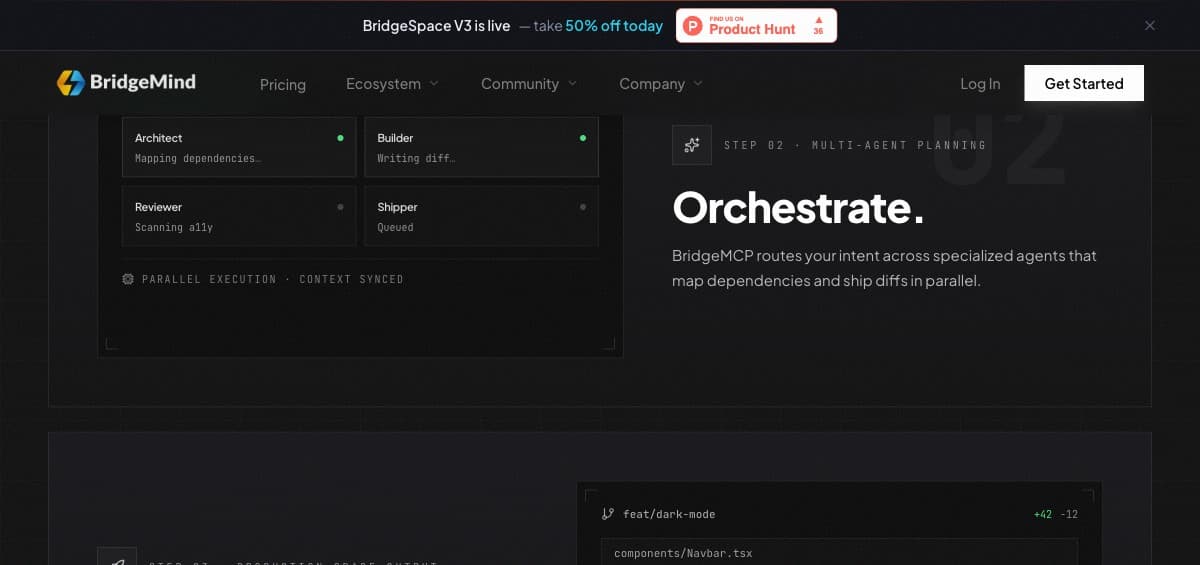
BridgeMind is an AI development platform built around agents instead of autocomplete. In a tool like Cursor, AI accelerates a programmer who is already writing code. In BridgeMind, the agents are the programmer: you describe the product, they break it into tasks, write the code, run it in a cloud sandbox, fix their own errors, and deploy. The human's job shifts from typing syntax to directing — what the industry now calls vibe coding.
What is BridgeSpace? It is the ADE — the Agentic Development Environment — and it is the part of BridgeMind you actually work in. Think of it as an IDE built for directing agents rather than typing code: you prompt, the agents plan and build, and you watch the work happen in a split grid. It runs in the cloud, so nothing is installed locally, which matters if you have never configured a dev environment. Every paid plan includes it, Basic upward. If you have seen the name BridgeSpace on its own and wondered whether it is a separate product, it is not — it ships inside the same subscription.
Around BridgeSpace sits the rest of the ecosystem, and one subscription covers all of it. Multi-agent Swarms run several agents in parallel on one project. BridgeMemory (Live) keeps project context between sessions, which is the thing a plain chatbot cannot do — close the tab, come back tomorrow, and the agents still know your codebase. BridgeMCP connects agents to your databases, APIs, and files through the open Model Context Protocol. BridgeVoice lets you direct agents by speaking, which sounds like a gimmick until you are describing a bug while looking at it. BridgeShot (macOS, beta) captures screen context. Bridge Assistant handles the general question-answering layer. Basic includes BridgeSpace, swarms, and the Assistant; BridgeMemory, BridgeMCP, and BridgeVoice unlock at Pro.
BridgeMind Pricing in 2026: What Each Plan Actually Buys
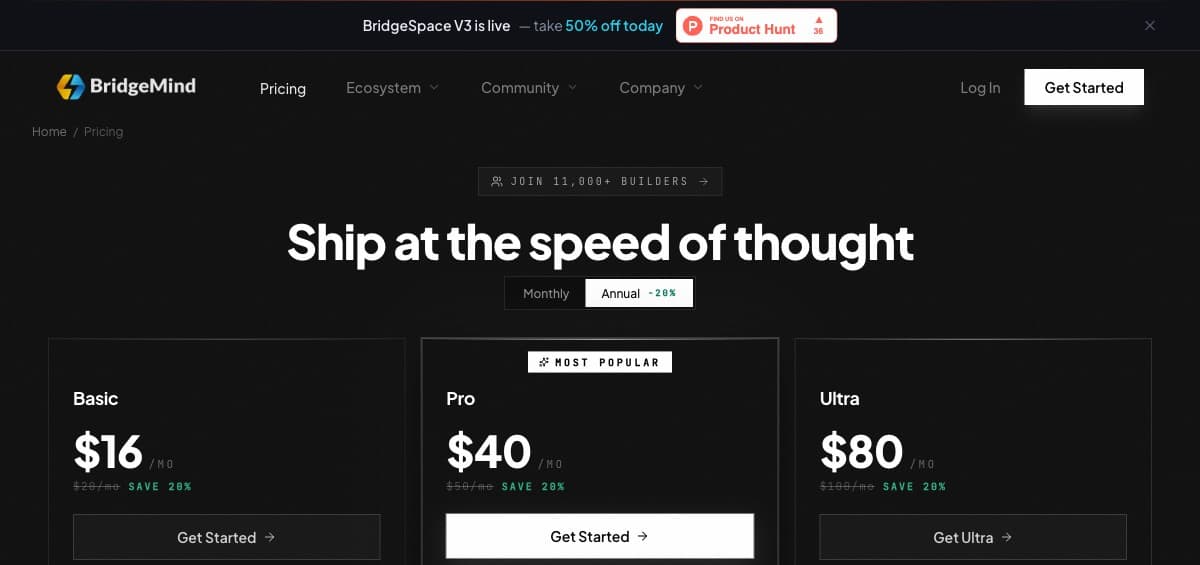
Pro costs $40/month on annual billing — $480 up front — or $50 month-to-month, and includes 12,500 agent credits, multi-agent swarms, and BridgeSpace access. That comfortably covers building and iterating one real project per month — most first-time users never exhaust it.
Everything is in that one plan: unlimited agents, workspaces and chats, named agents running on routines, and any coding CLI already on your PATH — Claude Code and Codex included. There is no tier above it to upgrade to and none below it to outgrow.
One thing worth knowing before you click: BridgeMind has no free tier. The one plan is $40/month on annual billing, or $50 month-to-month. What replaces the free trial is the 7-day money-back guarantee — you pay first, build something real inside the week, and get refunded if it isn't for you. Annual billing is where the 20% discount lives, but month-to-month is the honest way to test without locking a year in.
Pro
$40/mo
$50 month-to-month
12,500 credits/mo
- Unlimited agents, workspaces and chats
- Named agents on routines
- Any coding CLI on your PATH — Claude Code, Codex
- Plugin gateway: Apollo, vidIQ, Higgsfield, fal
Best for: The only plan — nothing to upgrade to
Real Results: The $1M ARR Challenge Numbers
The strongest evidence for BridgeMind isn't its feature list — it's that the founder is building a software business with his own product, in public, with the revenue dashboard on camera. The challenge: $0 to $1M ARR using BridgeMind agents, documented on a YouTube channel with 75K+ subscribers. At day 185 the verified figure was $201K ARR, run by one person with zero employees.
Why this matters for a buyer: most AI coding tools demo well on toy projects and fall apart on real ones. A founder whose income depends on his own agents shipping production software is the opposite of a cherry-picked demo. The challenge content also doubles as the best BridgeMind tutorial available — you watch real features get built, including the failures.

What BridgeMind Is Not Good At
An honest review needs the failure modes. First: garbage in, garbage out. Agents execute what you describe — a vague prompt like 'make a social app' produces a generic, buggy skeleton. Users who get value write briefs the way they'd brief a freelancer: specific features, specific behavior, specific edge cases.
Second: it's optimized for building new things, not maintaining old ones. If your goal is navigating a 500K-line legacy enterprise codebase, an IDE-native tool like Cursor fits better. Third: the credit model means a heavy builder on Basic can run dry before month-end — budget for Pro if BridgeMind becomes your daily driver. And the community is younger than Cursor's or Replit's, so when you hit an obscure problem, you'll lean on official support rather than a decade of Stack Overflow threads.
Verdict: Who Should Buy, Who Should Skip
Buy it if: you're a non-coder or early-stage founder who wants a real, deployed product — not a prototype — and you're willing to learn to write precise briefs. With a 7-day money-back guarantee, one week of honest use costs you nothing if you walk away, and the founder's public revenue numbers are the kind of proof no competitor currently offers.
Skip it if: you're a professional engineer happy in your IDE who wants faster code completion (get Cursor), you only need a pretty front-end demo (Lovable's free tier is gentler), or your work is maintaining large existing systems. BridgeMind wins one specific game — turning a person with product ideas into someone who ships software — and that's the game to judge it on.
The cons, in one place
- Credit-based usage — heavy daily builders can hit monthly limits on Basic
- Smaller community than Cursor or Replit, so fewer tutorials when stuck
- Vague prompts still produce buggy output — you must describe features precisely
- Not built for editing large existing enterprise codebases
Risk-free week
20% off your first 3 months.
Refunded in full if it isn't for you.
See BridgeMind PricingCode STARSEARN · 7-day money-back guaranteeFrequently Asked Questions
Is BridgeMind legit?
Yes. The founder builds his own software business with it live on YouTube (75K+ subscribers), with verifiable revenue — $201K ARR at day 185 of his public $1M challenge. There is a public Discord with 13,200+ builders, and every plan carries a 7-day money-back guarantee.
How much does BridgeMind cost?
There is one plan. Pro is $40/month on annual billing ($480 up front) or $50 month-to-month, with 12,500 agent credits and every feature included — BridgeMind removed its Basic and Ultra tiers in September 2026. Code STARSEARN takes 20% off every payment for your first three months. It cancels anytime, carries a 7-day money-back guarantee, and there is no free tier.
Is there a BridgeMind free trial?
No. BridgeMind has no free tier or free trial — the single Pro plan is $40/month on annual billing or $50 month-to-month. What it offers instead is a 7-day money-back guarantee on every plan: you pay, build something real inside the week, and request a refund if it isn't for you. If you want to test without committing to a year, start month-to-month rather than annual.
What does BridgeMind do?
BridgeMind turns a plain-language brief into working, deployed software. You describe the product; autonomous agents plan the tasks, write the code, run it, fix their own errors, and ship it. You review outcomes rather than syntax. Everything happens in BridgeSpace, its Agentic Development Environment, and one subscription covers the whole toolset rather than charging per tool.
What is BridgeSpace?
BridgeSpace is BridgeMind's ADE — Agentic Development Environment. It is the cloud workspace where you prompt agents and watch them plan, write, and run code in a split grid, with nothing installed locally. It is not sold separately — there is only one plan, and it includes everything.
What is BridgeBench?
BridgeBench is BridgeMind's open-source AI coding benchmark. It measures model speed, cost, and code quality across nine suites, pulling results direct from each provider rather than through aggregators, and publishes live leaderboards at bridgebench.ai. Over 60 models have been benchmarked and the project has drawn 100M+ views on X. It is free to read and does not require a BridgeMind subscription — useful as an independent check before you trust any vendor's own model claims.
Who is behind BridgeMind, and is the revenue real?
Founder Matthew Miller builds the business publicly on YouTube (75K+ subscribers), posting the numbers as he goes — $201,192 ARR at day 185 of his $1M challenge. That is unusually verifiable for this category: most AI-tool vendors publish neither revenue nor process. There is also a public Discord with 13,200+ builders, so the community size can be checked independently rather than taken on trust.
Is BridgeSpace the same as BridgeMind?
Not quite. BridgeMind is the whole platform and the subscription; BridgeSpace is the environment inside it where the work happens. The rest of the ecosystem — Multi-agent Swarms, BridgeMemory, BridgeMCP, BridgeVoice, BridgeShot, Bridge Assistant — sits around BridgeSpace under the same plan.
Do I need to know how to code to use BridgeMind?
No. The agents handle code, syntax, and debugging. What you do need is the ability to describe features precisely — users who treat prompts like a contractor brief get dramatically better results than users who write one-line wishes.
BridgeMind vs Cursor — which should I pick?
Different tools for different people. Cursor makes an existing programmer faster inside their IDE. BridgeMind replaces the programmer role with agents, which suits non-coders and founders shipping new products. If you've never written code, Cursor will frustrate you; if you live in an IDE, BridgeMind's agent loop may feel indirect.
Is BridgeMind a scam?
No, and it is unusually checkable for this category. The founder posts revenue publicly on a YouTube channel with 75K+ subscribers, including Stripe screenshots — $201,192 ARR at day 185 of his $1M challenge. There is a public Discord with 13,200+ builders and a 7-day money-back guarantee on every plan. The fair criticism is not that it is fake, it is that it is small and young compared with Cursor or Replit.
Is BridgeMind good?
It is the strongest option in its niche — non-coders and solo founders who want a finished product rather than faster typing. It is the wrong tool if you are an experienced engineer wanting smarter autocomplete in your existing IDE, or if you need to work inside a large legacy codebase. Judge it inside the 7-day refund window on one real project.
Is BridgeMind legit and safe to pay for?
Yes. Payment goes through standard billing, every plan cancels anytime, and the 7-day money-back guarantee is the practical protection — you can pay month-to-month, build something real inside the week, and get refunded if it does not suit you. The thing to avoid is committing to annual billing before you have tested the workflow.
What are people's biggest complaints about BridgeMind?
Three recur. Credit limits on the Basic tier bite if you build daily. The community is smaller than Cursor's or Replit's, so there are fewer tutorials when you get stuck. And vague prompts still produce buggy output — the tool amplifies how precisely you can describe things, which some people experience as the tool being unreliable.
What is BridgeMCP?
BridgeMCP is BridgeMind's Model Context Protocol support — it connects the agents to your databases, APIs and files through the same open standard that Claude Desktop and Cursor use for tool access. It unlocks at the Pro tier ($40/month annual). In practice it is what lets an agent work against your real data rather than only the code it wrote.
What is BridgeVoice?
BridgeVoice lets you direct the agents by speaking instead of typing. It sounds like a gimmick until you are describing a bug while looking at it, which is the case it is actually good for. Included from the Pro tier upward.
What is BridgeMemory?
BridgeMemory keeps project context between sessions — close the tab, come back tomorrow, and the agents still know your codebase and decisions. This is the capability a plain chatbot cannot replicate, because each new chat starts blank. Available from Pro.
Does BridgeMind have an app?
The platform runs in the browser — BridgeSpace is a cloud workspace, so there is nothing to install and no local dev environment to configure. BridgeShot is a macOS companion in beta that captures screen context for the agents, available from Pro.
How many credits do I actually need?
Basic's 5,000 monthly credits comfortably cover building and iterating one real project a month, which is where most first-time users land without running out. Pro's 12,500 is the tier for shipping client work or running a live product. If you are unsure, start on Basic month-to-month — hitting the limit is a clearer signal to upgrade than guessing upward.
Who is Matthew Miller?
Matthew Miller is the founder and CEO of BridgeMind. He is unusual among AI-tool founders in building the business publicly: daily updates on YouTube to 75K+ subscribers, with the revenue dashboard on camera as he works toward $1M ARR using his own product.
How much revenue does BridgeMind make?
The publicly documented figure is $201,192 ARR at day 185 of the founder's live $1M challenge, posted with verifiable Stripe screenshots rather than claimed in a blog post. Run by one person with zero employees. Treat the current number as higher than that snapshot — the challenge is ongoing and updated daily.
Is the BridgeMind revenue real or marketing?
It is about as verifiable as this category gets. The numbers appear on camera in daily videos, the Discord community size can be checked independently, and the challenge has run long enough that fabrication would have unravelled. Most competitors publish neither revenue nor process, so the comparison is not close.
How do I get started with BridgeMind?
Pick Basic month-to-month, describe one small complete project in plain language — a landing page, a calculator, a Telegram bot — and watch the agents build it in BridgeSpace. Request changes the way you would brief a contractor. Judge the whole thing inside the 7-day refund window rather than reading more reviews.
What should my first BridgeMind prompt look like?
Like a brief, not a wish. Name the screens, the data you store, and what should happen when something fails. 'Build me an app' produces guesswork; 'a page where users enter an amount, it converts to USD at a live rate, and shows an error if the API is down' produces working code. Precision in the prompt is the single biggest lever on output quality.
Is there a BridgeMind discount or promo code?
The standing discount is code STARSEARN, which takes 20% off every payment for your first three months. Annual billing separately drops the $50 monthly price to $40. There is no other coupon system to hunt for. Given how fast this category changes, the month-to-month price is often the smarter deal even without the discount.
Can BridgeMind build a Telegram bot or mini app?
Yes, and it is a good fit for it: a Telegram bot is a small, well-defined project of exactly the kind agents handle well, including Stars payments and a Postgres database. The two places to read the code yourself before going live are the payment handling and whatever decides who gets access after paying.
Related Guides
BridgeMind Alternatives in 2026: Which AI Coding Tool Actually Fits You?
Not a list. A real comparison table + 3-question quiz that tells you which tool to use based on what you're building and how much you know about code.
Cursor Alternatives in 2026: 5 Tools Compared by Who Should Switch
Cursor's $20 credit pool runs out, teams pay $20 a seat, and you're locked into a VS Code fork. Five real alternatives compared on price, limits, and who each one actually suits.
BridgeMind vs Cursor: Same Startup Brief, 5 Rounds, One Honest Winner
The same brief through both AI tools: a crypto SaaS built from scratch. Every metric compared — speed, bugs, UI, deploy — from documented test builds. Honest winner inside.