

Is Coinbase safe? Yes — but know what isn't covered
Published · How we check
The company is safe; your account is the weak point. Coinbase keeps over 99% of customer crypto in cold storage, is audited and S&P 500-listed, and its user agreement says your crypto never becomes its property. But crypto on Coinbase isn't FDIC-insured, its theft insurance covers only part of its own storage — and nothing covers a stolen login, which is how people actually lose coins there.
 Want proof of reserves and lower fees? Kraken publishes reserves since 2014; Kraken Pro charges 0.40% / 0.80% →
Coinbase Safety Check: 8 Things, From Its Own Pages
Public and regulated
Listed on NASDAQ and in the S&P 500, quarterly reviewed and annually audited; 80+ licenses. Its US custodian is a New York trust company supervised by the NYDFS.
Safe · Coinbase, 4 Nov 2026 ↗Over 99% in cold storage
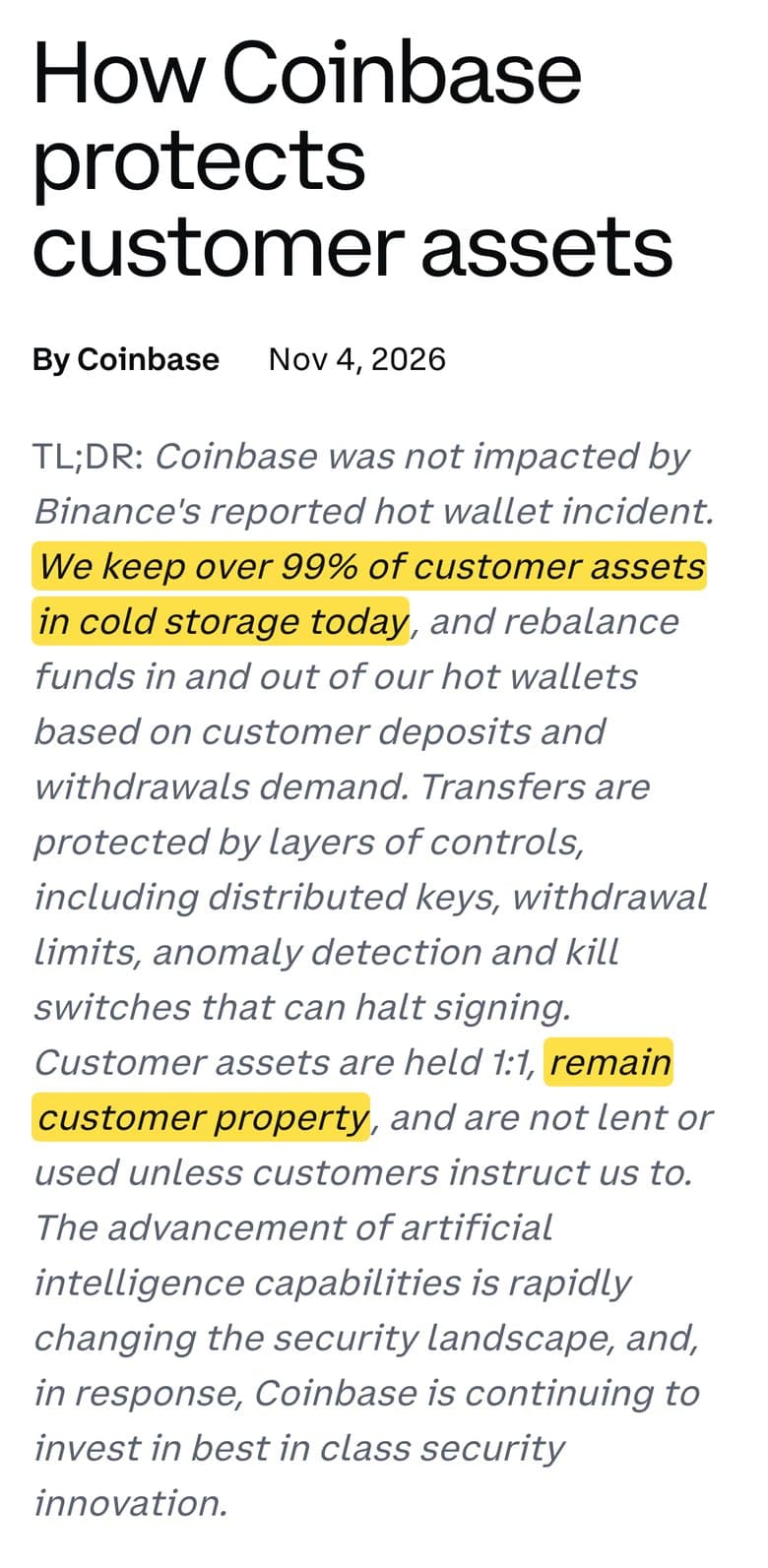
Keys split so no full key is ever rebuilt; withdrawal limits, anomaly detection and kill switches on every transfer.
Safe · Coinbase, 4 Nov 2026 ↗Your crypto stays yours
"Title to Supported Digital Assets shall at all times remain with you" — they are "not property of Coinbase". Held 1:1, not lent out unless you ask.
Safe · User Agreement §2.7.1 ↗US dollars: FDIC pass-through
USD held as cash sits in FDIC- or NCUSIF-insured accounts "for the benefit of" customers, up to $250,000 per customer if a partner bank fails (US only).
Safe · Coinbase Help ↗Crypto insurance covers only a portion
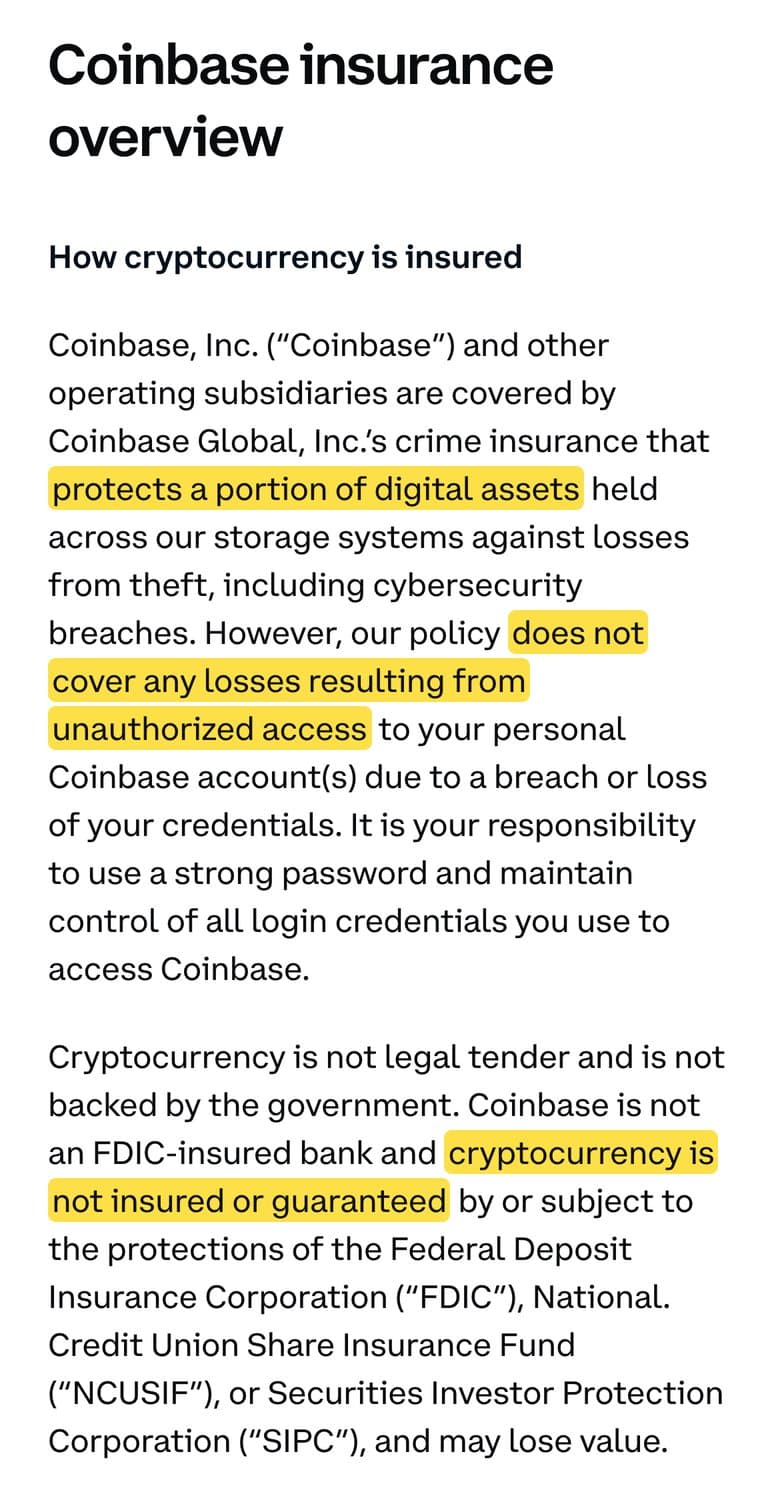
Crime insurance covers "a portion of digital assets" against theft from Coinbase's storage — not FDIC or SIPC, and "total losses may exceed insurance recoveries".
Careful · Coinbase insurance overview ↗No Merkle proof of reserves
Coinbase points to its audited filings and 1:1 custody instead. Kraken has published proof of reserves since 2014.
Careful · Kraken PoR ↗Stolen logins aren't covered
The insurance "does not cover any losses resulting from unauthorized access to your personal Coinbase account(s)" — the way most people actually lose crypto.
Risk · Coinbase insurance overview ↗2025: support agents sold customer data
Bribed overseas support agents copied names, addresses, ID images and balances of under 1% of monthly users; scammers then phoned them posing as Coinbase.
Risk · Coinbase, 15 May 2025 ↗Is Coinbase Insured? What's Covered and What Isn't
Covered
- US dollars held as cash — FDIC or NCUSIF pass-through, up to $250,000 per customer, if a partner bank fails
- Theft from Coinbase's own storage, including a cyber breach — by crime insurance, for a portion of assets
- Stocks and cash at Coinbase Capital Markets — SIPC, up to $500,000
Not covered
- Crypto by FDIC, NCUSIF or SIPC — ever
- Someone getting into your account with your password or 2FA
- Crypto you send to a scammer yourself
- Price drops
Where Coinbase Keeps Your Crypto
On 4 November 2026, after a reported hot-wallet incident at Binance, Coinbase published how it stores customer assets: over 99% in cold wallets, private keys split so the full key is never rebuilt even while signing, strict limits on refilling hot wallets, and kill switches that take signing keys offline. It also restated that assets are held 1:1, remain customer property and are not lent unless you ask.
If Coinbase went bankrupt: its US user agreement (§2.7.1) says title to your crypto “shall at all times remain with you” and that assets held for customers “are not property of Coinbase”. Margin products are the exception — there, assets Coinbase reuses can become a general unsecured claim.
The 2025 Coinbase Data Breach: What Leaked
On 15 May 2025 Coinbase disclosed that criminals had bribed overseas support agents to copy customer data for under 1% of monthly transacting users, then demanded $20 million. Coinbase refused, put up a $20 million reward instead and said it would reimburse customers tricked into sending funds.
Leaked
- Name, address, phone, email
- Last 4 of SSN
- Masked bank numbers
- ID images
- Balances and history
Not leaked
- Passwords, 2FA codes
- Private keys
- Access to funds
- Hot or cold wallets
- Prime accounts
The data was used for one thing: calls and texts from “Coinbase support” telling people their account was compromised and to move funds to a new wallet. Coinbase never makes that call.
Is Coinbase Legit? Country by Country
Yes — Coinbase is a legitimate, regulated company everywhere it operates. What changes from country to country is who supervises it and what protects your money.
Has Coinbase Been Hacked?
Coinbase's own disclosures describe its two known incidents as account-level — customer logins and customer data — not thefts from its storage. That's why the lock-down steps below matter more than the company's vaults.
March – May 2021
The SMS recovery flaw. Attackers exploited a flaw in Coinbase's SMS account-recovery process to get into at least 6,000 customer accounts and move their crypto out. Coinbase fixed the flaw and reimbursed the funds (Reuters, 1 Oct 2021). It's the reason to use a passkey or security key instead of SMS.
May 2025
The insider data leak. Bribed support agents copied data on under 1% of monthly users, which scammers used for fake “Coinbase support” calls. No passwords, keys or funds were taken (details above).
November 2026
Not affected by Binance's reported hot-wallet incident, Coinbase says, with over 99% of customer assets in cold storage.
Is Coinbase safe from hackers? Its storage has held up; accounts are the target. Phishing, SIM swaps and fake support calls work because they steal your login, and Coinbase's insurance doesn't cover that.
Lock Down Your Coinbase Account in 5 Steps
These close the gap the insurance leaves — a stolen login or a scam call.
Tap each one once you've turned it on. Saved on this device.
1. Use a passkey or security key, not SMS
2-step verification by text can be stolen with a SIM swap. Coinbase supports security keys and passkeys. How, on Coinbase's help page
2. Turn on address-book allowlisting
Crypto can then be sent only to addresses you saved — a thief in your account can't add their own on the spot. How, on Coinbase's help page
3. Park long-term coins in a vault
Vault withdrawals need approval, optionally from people you trust; unapproved ones are cancelled after 24 hours. How, on Coinbase's help page
4. Hang up on "Coinbase support" calls
Coinbase: "We will never call or SMS you to request account access." Never move funds to a "safe" wallet someone gives you. How, on Coinbase's help page
5. Give Coinbase its own email and password
A unique email and password manager entry for Coinbase stops one leaked login elsewhere from opening it. How, on Coinbase's help page
Coinbase vs Kraken: Which Is Safer?


Kraken: proof of reserves published since 2014; BTC 102.9%, ETH 100.5% on 30 Jun 2026; no customer funds lost to a hack; a 2024 bug cost Kraken about $3M of its own money, returned; serves every US state except New York and Maine. Coinbase: from its pages above.
If what worries you is fees rather than safety, Kraken Pro charges 0.40% / 0.80% a trade against Coinbase Advanced's reported 0.60% / 1.20% — compare every option in Coinbase alternatives. In the US, see Kraken as a Coinbase alternative, or rank 9 exchanges by what you keep.
 Open Kraken Pro
Kraken app — simplest
Same account · one tap · 1% + spread
Deposit $100, buy crypto for $100 — get $10 back
Related
Frequently Asked Questions
Is Coinbase legit?
Yes. Coinbase is a NASDAQ-listed, S&P 500 company with US state licenses, an FCA registration in the UK, MiCA authorization in the EU, a Restricted Dealer registration in Canada and an AUSTRAC registration in Australia. Legit isn't the same as risk-free: crypto on Coinbase isn't FDIC-insured and its insurance doesn't cover a stolen login.
Is Coinbase federally insured?
Only your US dollars: held as cash, they sit in FDIC- or NCUSIF-insured accounts with pass-through coverage up to $250,000 per customer. Crypto isn't federally insured — not by the FDIC, NCUSIF or SIPC.
Is Coinbase insured in the UK or Canada?
In the UK, Coinbase's crypto business (CB Payments Ltd) is registered with the FCA, but most crypto isn't a specified investment, so customers are unlikely to have the Financial Ombudsman or FSCS behind them. In Canada, Coinbase says crypto isn't covered by CDIC or CIPF. In both, Coinbase's crime insurance covers a portion of assets against theft from its own storage.
Was Coinbase hacked?
Not its wallets, by its own account. In March–May 2021 attackers abused a flaw in its SMS account recovery to get into at least 6,000 customer accounts; Coinbase fixed it and reimbursed them (Reuters). In May 2025 bribed support agents leaked customer data. Both were account-level, which is why a passkey, address allowlisting and a vault matter.
What is a Coinbase scam text message?
A text or call that claims to be Coinbase, says your account is compromised and asks you to log in through a link, share a code or move funds to a 'safe' wallet. Coinbase's help center says it will never call or SMS you to request account access. Don't reply — open the Coinbase app yourself.
Is Coinbase safe?
As a company, yes: it's listed on NASDAQ and in the S&P 500, audited, licensed in 80+ jurisdictions, keeps over 99% of customer crypto in cold storage and, under its user agreement, never owns your crypto. The risk is your account: Coinbase's insurance doesn't cover losses from a stolen login, and in 2025 bribed support agents leaked customer data that scammers used to phone people posing as Coinbase. A passkey, address allowlisting and a vault close most of that gap.
Is my money insured on Coinbase?
Your US dollars, yes: held as cash, they sit in FDIC- or NCUSIF-insured accounts with pass-through coverage up to $250,000 per customer if a partner bank fails (US customers of Coinbase, Inc.). Your crypto, only partly: Coinbase's crime insurance covers a portion of assets against theft from its own storage, not FDIC or SIPC, and not losses from someone getting into your account.
What happens to my crypto if Coinbase goes bankrupt?
Coinbase's US user agreement (§2.7.1) says title to your crypto stays with you, never transfers to Coinbase, and assets held for customers are not property of Coinbase. Coinbase says it holds them 1:1 and doesn't lend them unless you instruct it to. Margin or lending products are different: there, reused assets can become a general unsecured claim.
Has Coinbase ever been hacked?
Its best-known incident is an insider leak, not a wallet hack. In May 2025 Coinbase disclosed that criminals bribed overseas support agents to copy data on under 1% of monthly transacting users — names, addresses, ID images, masked Social Security and bank numbers, balances. No passwords, 2FA codes, private keys or funds were taken; Coinbase refused a $20 million ransom and said it would reimburse customers tricked into sending funds.
Will Coinbase ever call me?
Not to ask for access. Coinbase's help center says it will never call or SMS you to request account access. A call saying your account is compromised and you must move funds to a new wallet is the scam that followed the 2025 data leak.
Is Coinbase safe for large amounts?
For large balances, use a vault (withdrawals need approval and are cancelled after 24 hours if not approved), allowlisting and a security key — or move what you don't trade to a wallet you control. Coinbase's crime insurance covers only a portion of assets and total losses may exceed it, so no exchange should be your only copy of a large holding.
Is Kraken safer than Coinbase?
Different strengths. Kraken has published proof of reserves since 2014 and has never lost customer funds to a hack; Coinbase is a public, S&P 500 company with audited filings and FDIC pass-through coverage on US dollars. Kraken's trading fees are also lower: 0.40% / 0.80% on Kraken Pro against a reported 0.60% / 1.20% on Coinbase Advanced.
Is it safe to link my bank account to Coinbase?
Generally yes, and US dollars you move in are held in FDIC- or NCUSIF-insured accounts with pass-through coverage up to $250,000. The 2025 leak included masked bank-account numbers and some bank identifiers, so expect scam calls that quote them: never act on a call or text — open the app and log in yourself.
Sources
- Coinbase: How Coinbase protects customer assets (4 Nov 2026) (read 13–14 Nov 2026)
- Coinbase insurance overview (read 13–14 Nov 2026)
- Coinbase: How U.S. Dollar cash is stored (read 13–14 Nov 2026)
- Coinbase User Agreement (US), §2.7 Digital Asset Custody and Title (read 13–14 Nov 2026)
- Coinbase: Protecting our customers — standing up to extortionists (15 May 2025) (read 13–14 Nov 2026)
- Coinbase Help: 2-step verification (security keys, passkeys) (read 13–14 Nov 2026)
- Coinbase Help: address book allowlist (read 13–14 Nov 2026)
- Coinbase Help: vaults (read 13–14 Nov 2026)
- Coinbase Help: technical support and impersonation scams (read 13–14 Nov 2026)
- Kraken Proof of Reserves (read 13–14 Nov 2026)
- Reuters: Coinbase says hackers stole cryptocurrency from at least 6,000 customers (1 Oct 2021) (read 13–14 Nov 2026)
- Coinbase obtains registration as a Restricted Dealer in Canada (3 Apr 2024) (read 13–14 Nov 2026)
- Coinbase Australia (AUSTRAC registration) (read 13–14 Nov 2026)
- FCA register: CB Payments Ltd (read 13–14 Nov 2026)
StarsEarn isn't affiliated with Coinbase. Kraken pays us a commission when you sign up through our button.